
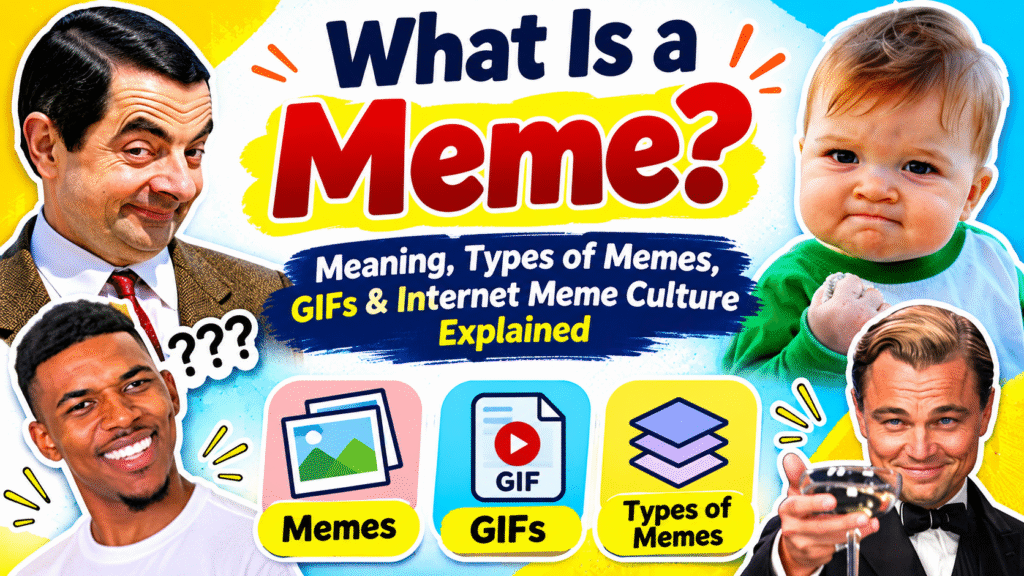
Have you ever opened Instagram, WhatsApp, or another social media app and found yourself laughing at a picture with just a few words written on it? Maybe it was a funny movie scene, a confused-looking cat, or a reaction that perfectly described your day.
That’s the magic of internet memes.
Memes have become one of the most recognizable ways people communicate online. They help us share jokes, express emotions, react to everyday situations, and sometimes explain complicated ideas with surprising simplicity.
But what exactly is a meme? How is it different from a GIF? And why do certain memes become popular while thousands of others disappear almost immediately?
Let’s explore the world of memes, from their meaning and origins to the different formats that shape internet culture today.
What Is a Meme?
A meme is an idea, image, video, phrase, or piece of content that people share, imitate, and modify, often to express humor, emotions, opinions, or relatable experiences.
On the internet, memes commonly appear as funny images with captions, short video clips, reaction GIFs, or recognizable expressions taken from movies and popular culture.
For example, imagine a picture of someone looking completely exhausted with the caption:
“Me after attending one meeting that could have been an email.”
The picture alone might not be particularly funny. But when combined with a relatable caption, it becomes something people immediately understand and want to share.
That’s what makes memes special. They turn ordinary situations into shared experiences.
However, memes aren’t always jokes. Some communicate frustration, celebrate achievements, comment on current events, or express feelings that are difficult to describe in words.
What Does Meme Mean?
The word meme was introduced by evolutionary biologist Richard Dawkins in his 1976 book The Selfish Gene.
Originally, it described an idea or cultural behavior that spreads from one person to another through imitation.
The modern internet meme is a digital expression of this broader concept.
Instead of spreading only through conversation or traditional media, memes now travel through social networks, messaging apps, online communities, and video platforms.
A meme might begin with a single image, but people can create hundreds of variations by changing the caption, adding a new situation, or combining it with another popular trend.
How Do Internet Memes Work?
Most internet memes follow a simple pattern.
Someone creates or shares a recognizable piece of content. Other people discover it, find it entertaining or relatable, and share it with their friends.
Eventually, someone changes the original version to fit a different situation.
Imagine a picture of a person celebrating.
One version might say:
“When your salary finally arrives.”
Another might say:
“When the teacher cancels the exam.”
The image stays the same, but the meaning changes depending on the caption.
This ability to adapt is one of the biggest reasons memes spread so easily.
Successful memes often share three qualities: they are easy to understand, relatable to a particular audience, and simple enough for other people to recreate.
Different Types of Memes
Internet memes come in many forms. Some rely on pictures and captions, while others use video, animation, audio, or recognizable reactions.
Here are some of the most common types.
1. Image Memes
Image memes are among the most familiar formats on the internet.
They usually combine a photograph, illustration, or screenshot with a short caption.
The image provides the visual context, while the text delivers the joke or message.
For example, a photograph of someone looking confused could represent the feeling of opening a difficult examination paper.
Image memes are popular because they’re easy to create, quick to understand, and convenient to share.
2. Reaction Memes
Reaction memes help people express feelings without writing a lengthy response.
They can communicate happiness, disappointment, shock, confusion, excitement, or sarcasm.
Imagine receiving unexpected good news from a friend. Instead of replying with several sentences, you might send a picture of someone celebrating.
Similarly, a dramatic movie expression can communicate disbelief more effectively than simply typing “What?”
Reaction memes are especially useful in online conversations because they add personality and emotion.
3. Video Memes
Video memes use short clips to communicate humor, reactions, or recognizable situations.
These clips may come from movies, television shows, interviews, gaming sessions, or original recordings.
A video meme might feature a funny expression, an unexpected response, or a dramatic moment that works perfectly in a different context.
Unlike static images, video memes can use movement, dialogue, timing, and sound to make the joke more effective.
Short-form video platforms have made this format particularly accessible.
4. GIF Memes
GIF memes are animated images that often play repeatedly in a loop.
They are commonly used to show reactions such as laughing, clapping, celebrating, or expressing disbelief.
For example, an animated clip of someone slowly applauding might be used as a sarcastic response to an obvious statement.
GIFs are convenient because they communicate movement and emotion without requiring someone to watch a full video.
Not every GIF is a meme, though. A GIF becomes part of meme culture when people use and share it to express a recognizable idea, joke, or reaction.
5. Bollywood Memes
Bollywood memes are especially popular among audiences familiar with Indian cinema.
They use recognizable movie dialogues, facial expressions, dramatic scenes, and memorable characters to represent everyday situations.
A funny reaction from a comedy film might describe someone’s experience at work, while an emotional movie scene could be used to exaggerate a minor disappointment.
The humor often comes from placing a familiar cinematic moment into an entirely different situation.
Bollywood memes also show how internet humor can reflect regional languages, cultural references, and shared entertainment experiences.
6. Gaming Memes
Gaming memes focus on experiences that gamers immediately recognize.
Common topics include unexpected defeats, difficult levels, multiplayer teammates, gaming bugs, and memorable in-game moments.
For example, a meme about losing a match after nearly winning might be particularly relatable to competitive players.
Gaming memes often develop inside specific communities, where players share jokes based on common experiences.
7. Relatable Memes
Relatable memes describe ordinary situations that many people experience.
They often focus on school, office life, family conversations, relationships, money, sleep, or everyday frustrations.
A meme about setting five alarms and still waking up late works because the situation feels familiar.
Relatable memes don’t always need famous characters or complicated editing. Sometimes a simple picture and an accurate caption are enough.
8. Dank and Surreal Memes
Dank memes often feature unusual humor, exaggerated editing, irony, or references to internet culture.
Surreal memes take this further by using deliberately strange images, unexpected combinations, and absurd situations.
These formats may seem confusing to someone unfamiliar with the joke, but that’s sometimes part of their appeal.
They demonstrate how internet humor continues to evolve as communities develop their own styles and references.
9. Meme Templates
A meme template is a reusable image or format that people can customize with their own text or ideas.
Some templates have blank spaces for captions. Others use recognizable facial expressions or contrasting scenes.
For example, a two-panel template might show someone rejecting one option and enthusiastically choosing another.
People can reuse that structure to compare almost anything, from food preferences to everyday decisions.
Templates help memes spread because they make participation easy.
10. Sound Memes
Sound memes use short audio clips, recognizable dialogue, sound effects, or musical moments to create humor.
They are frequently used in video edits, gaming content, and social media reactions.
Sometimes a familiar sound is enough to make an otherwise ordinary scene funny.
Sound memes can also become part of larger trends when different creators use the same audio in new situations.
What Is a GIF?
A GIF, short for Graphics Interchange Format, is a digital image format introduced by CompuServe in 1987.
GIF files can contain a single still image or multiple frames that create an animation.
Animated GIFs often repeat automatically, making them useful for short visual reactions and simple motion graphics.
Unlike ordinary videos, GIF animations generally don’t include sound.
You’ve probably seen GIFs showing someone laughing, waving, dancing, or giving a thumbs-up.
These short animations have become a familiar part of online conversations.
How Do GIFs Work?
An animated GIF stores multiple image frames in a single file.
When those frames are displayed in sequence, they create the appearance of movement.
Think of a flipbook. Each page contains a slightly different drawing, and flipping the pages quickly makes the subject appear to move.
Animated GIFs work on a similar principle.
They are useful for short animations, although modern video formats can be more efficient for longer or visually complex clips.
What Is GIPHY?
GIPHY is an online platform for discovering and sharing GIFs, animated stickers, and short visual reactions.
People commonly use GIPHY to find animations that match a particular emotion or situation.
For example, searching for “happy,” “confused,” or “celebration” can help users find suitable reactions.
GIPHY is the name of a platform, while GIF is the name of an image format. They are not the same thing.
Meme vs GIF: What’s the Difference?
Although memes and GIFs are often used together, they describe different things.
A meme is primarily a cultural idea or recognizable piece of content that spreads between people.
A GIF is a technical image format.
A meme can be a photograph, text, video, GIF, or even an audio clip. A GIF, meanwhile, can simply be an animation without any particular cultural meaning.
| Feature | Meme | GIF |
|---|---|---|
| Meaning | A shared cultural idea or expression | Graphics Interchange Format |
| Main purpose | Communicate humor, ideas, or reactions | Display still or animated images |
| Format | Image, text, video, audio, or animation | Image file format |
| Animation | Optional | Supported |
| Sound | Possible in video or audio memes | Not supported in standard GIF files |
| Typical example | A funny image with a relatable caption | A looping animation of someone laughing |
The easiest way to remember the difference: A GIF can be used as a meme, but not every meme is a GIF, and not every GIF is a meme.
Why Are Memes So Popular?
Memes are popular because they fit naturally into the way people communicate online.
They are quick, expressive, adaptable, and often entertaining.
They Make Communication Easier
Sometimes a funny picture communicates an emotion more effectively than a paragraph of text.
A single reaction image can express surprise, frustration, excitement, or disappointment instantly.
They Bring People Together
People enjoy recognizing shared experiences.
A meme about Monday mornings might resonate with office workers, while a meme about examination stress might connect with students.
When people recognize themselves in a joke, they are more likely to share it.
They Encourage Creativity
One of the most interesting aspects of meme culture is that people rarely stop at the original version.
They create new captions, remix existing formats, and combine different references.
This constant reinterpretation keeps meme culture active.
They Reflect Current Culture
Memes frequently respond to entertainment, technology, sports, gaming, and everyday social experiences.
As people’s interests change, meme formats and references change too.
A joke that was widely understood several years ago might make little sense to a younger audience today.
That’s part of what makes internet culture so dynamic.
How Do Memes Go Viral?
A viral meme spreads rapidly across online communities.
But there’s no guaranteed formula for making one.
Some memes become popular because they capture a feeling at exactly the right moment. Others spread because the format is easy to recreate.
A recognizable reaction, a clever caption, and an audience that understands the reference can all contribute to a meme’s popularity.
Sharing also plays an important role.
A meme may begin in a small online community, move to a larger social platform, and eventually appear in group chats, videos, and other websites.
However, popularity doesn’t always last.
Some memes remain recognizable for years, while others disappear after a brief trend.
How to Create Your Own Meme
You don’t need professional editing skills to create a meme.
The most important ingredient is a clear idea.
Step 1: Choose a relatable situation.
Think about something people in your intended audience experience regularly, such as waking up early, waiting for a message, or dealing with a slow internet connection.
Step 2: Find or create a suitable visual.
You can use an original photograph, illustration, or a reusable template that you’re permitted to use.
Step 3: Write a short caption.
Keep the message simple. A good caption should make sense without requiring a lengthy explanation.
Step 4: Make the text readable.
Use clear fonts and enough contrast between the text and background.
Step 5: Share it with the right audience.
A gaming joke might work best in a gaming community, while a workplace meme may resonate more with office workers.
Remember that not every meme needs to become viral. A joke that makes a small group of people laugh can still be a successful meme.
Can You Download and Share Memes for Free?
Many websites and social platforms allow people to view, save, or share memes and GIFs.
However, free access does not automatically mean a meme is copyright-free.
Some memes contain photographs, movie scenes, illustrations, music, or other creative material owned by someone else.
Copyright rules, licensing terms, platform policies, and exceptions such as fair use may affect how particular content can be reused.
Sharing a meme privately, reposting it publicly, and using it commercially are not necessarily treated the same way.
Before reusing content, especially on a commercial website or in advertising, it’s worth checking the relevant rights and permissions.
Where Can You Find Memes and GIFs?
Memes appear across social media, online communities, messaging platforms, and dedicated meme websites.
Different platforms serve different purposes.
Some focus on animated reactions, while others feature image templates, short videos, or community-created humor.
For example, GIPHY is widely associated with GIF discovery, while Reddit communities often discuss and share emerging internet jokes.
On MemesTube.in, visitors can explore meme-related content, including funny memes, reaction clips, GIFs, and recognizable entertainment moments.
Whether you’re looking for a quick laugh or trying to understand a trending reaction, exploring different meme formats is a good way to discover how internet humor works.
The Future of Internet Memes
Internet memes have changed considerably over time.
Early internet humor often relied on simple captioned images. Today, memes can involve short videos, elaborate edits, animated reactions, sound clips, and interactive formats.
Artificial intelligence has also introduced new ways to generate and edit visual content.
At the same time, memes continue to reflect the communities that create them.
Different languages, regions, and online groups develop their own humor, references, and recognizable formats.
The technology may change, but the underlying idea remains familiar: people enjoy sharing experiences and expressing themselves creatively.
As long as people continue communicating online, memes are likely to remain part of digital culture.
Frequently Asked Questions About Memes and GIFs
What is the full form of meme?
Meme is not an acronym, so it doesn’t have a full form. The term was introduced by Richard Dawkins and is associated with the spread of cultural ideas through imitation.
What is the full form of GIF?
GIF stands for Graphics Interchange Format.
Are memes and GIFs the same thing?
No. A meme is a cultural idea or piece of content that spreads through sharing and imitation, while a GIF is an image file format. Some animated GIFs are used as memes.
Can a meme be a video?
Yes. Memes can take many forms, including images, videos, text, audio clips, and animations.
Why are memes funny?
Memes often combine familiar situations with unexpected captions, exaggerated reactions, or clever cultural references. Humor is subjective, so not everyone will find the same meme funny.
What is a reaction meme?
A reaction meme is an image, animation, or video clip used to express a feeling or response, such as excitement, confusion, disappointment, or surprise.
What is a meme template?
A meme template is a reusable image or layout that people customize with captions or other elements to create new variations.
Are all internet memes copyrighted?
Not necessarily. Copyright status depends on the original material and applicable law. Some material may be licensed for reuse or be in the public domain, while other content may be protected.
What makes a meme go viral?
Relatability, timing, humor, easy sharing, and the ability to create new variations can all contribute to a meme spreading rapidly. None guarantees viral success.
What is the difference between a meme and a viral video?
A viral video is a video that spreads widely. A meme is a recognizable idea or format that people share and often adapt. A viral video can become a meme when people repeatedly reference, imitate, or remix it.
Final Thoughts
Memes are more than funny pictures on the internet. They are a creative form of communication that brings together humor, culture, emotions, and everyday experiences.
From classic image memes and Bollywood reactions to animated GIFs and short video clips, each format offers a different way to express an idea.
Understanding the difference between memes, GIFs, and meme templates makes it easier to explore internet culture and even create your own content.
The next time you see a funny image in a group chat or a looping reaction on social media, you’ll know there’s more behind it than just a quick joke.
Explore MemesTube.in to discover funny memes, reaction GIFs, meme videos, and more from the world of internet humor.